You move into a new apartment or a new city.
A few weeks later, something feels different.
Your hair is harder to brush. It feels dry no matter what conditioner you use. Shampoo does not lather as well. Your scalp feels tighter after every shower, and your hair seems flatter than it used to.
Eventually, a question starts creeping in:
Can hard water cause hair loss?
It is one of the most searched hair care questions online, yet many of the answers are either overly simplistic or scientifically inaccurate.
The short answer is this: hard water has not been proven to directly cause male pattern hair loss. However, it can absolutely affect the condition of your hair and scalp in ways that make thinning hair appear more noticeable and healthy hair more difficult to maintain.
Understanding that distinction is important.
What Is Hard Water?

Hard water contains higher concentrations of naturally occurring minerals, primarily calcium and magnesium.
These minerals are not harmful to your health. In fact, many are beneficial when consumed through drinking water.
The issue begins when those minerals repeatedly interact with your hair and scalp.
Over time, mineral deposits can accumulate on the hair shaft, leaving hair feeling rougher, heavier, and more difficult to manage. Some people also notice increased dryness, reduced shine, or a feeling that their hair never feels completely clean after washing.
These cosmetic changes often lead people to believe they are losing hair, even when the follicles themselves remain healthy.
Why Hard Water Can Make Hair Look Thinner
Hair density is not just about the number of hairs on your head.
It is also about how those hairs behave.
Healthy strands naturally separate, reflect light evenly, and create volume. When mineral buildup weighs the hair down, that volume can disappear.
Hair may cling together after drying, exposing more of the scalp underneath. Individual strands can appear dull instead of healthy. Fine hair may lose body altogether.
If you recently noticed your scalp becoming more visible after moving to an area with hard water, the change may have more to do with the condition of your hair than the number of follicles producing it.
This is similar to what we discussed in our articles about why hair looks thinner under bright lights and why your scalp becomes more visible when your hair is wet. Small changes in the way hair reflects light can create surprisingly large differences in perceived density.
What the Research Says

Researchers have investigated whether hard water damages the hair itself.
One laboratory study published in the International Journal of Trichology found that repeated washing with hard water resulted in hair fibers becoming rougher and less smooth compared with distilled water. The study did not conclude that hard water causes hair loss, but it demonstrated measurable changes to the physical properties of the hair shaft.
That distinction matters.
Damaged hair fibers and male pattern hair loss are two different biological processes.
Hair breakage happens above the scalp.
Hair loss caused by androgenetic alopecia begins below the scalp, where DHT gradually miniaturizes genetically susceptible follicles over time.
Why Scalp Health Still Matters

Although hard water has not been shown to directly trigger androgenetic alopecia, scalp health remains one of the most important factors in any long term hair care routine.
A scalp that feels excessively dry, irritated, or covered with product and mineral buildup may be less comfortable and more difficult to care for consistently.
That growing understanding is one reason rosemary oil has become one of the most discussed ingredients in modern hair care.
A clinical study published on PubMed compared rosemary oil with 2% minoxidil in individuals with androgenetic alopecia. After six months of consistent use, researchers found that participants using rosemary oil experienced significant increases in hair count. The findings suggested that rosemary oil may help support healthier hair growth when used as part of a long term routine.
If you would like to learn more about the science behind scalp focused hair care, our Why It Works page explains the research and formulation philosophy behind our approach.
How to Tell Whether Hard Water Is Affecting Your Hair

The effects usually develop gradually rather than overnight.
Many people first notice that their shampoo no longer produces the same lather. Hair may feel coated after washing or become increasingly difficult to style. Others notice that their hair loses volume more quickly, making existing thinning appear more pronounced.
If these changes coincide with moving to a new home or traveling to an area known for hard water, the water itself may be contributing to the way your hair looks and feels.
That does not necessarily mean your hair follicles are becoming weaker.
It may simply mean your hair needs a different approach to scalp and strand care.
A Healthy Hair Routine Looks Beyond One Variable


Hair growth is influenced by dozens of factors.
Genetics, DHT sensitivity, nutrition, stress, hair growth cycles, scalp health, and daily habits all contribute to the condition of your hair over time.
That is why focusing on a single variable rarely tells the full story.
The strongest routines are built around consistency, realistic expectations, and products designed to support the scalp over the long term rather than chase overnight results.
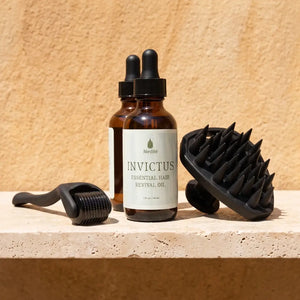
Our Invictus Essential Hair Revival Oil was developed with that philosophy in mind, using a premium rosemary oil formulation designed for daily scalp care.
If you're building your first complete routine, the Medíté Starter Kit offers a simple place to begin and currently includes complimentary free U.S. shipping over $35 and free welcome gifts.
The Bottom Line
Hard water is unlikely to be the hidden cause of male pattern hair loss.
What it can do is change the way your hair behaves. Mineral buildup may leave hair feeling rougher, flatter, and less voluminous, making natural scalp visibility more noticeable.
Understanding the difference between hair damage and hair loss allows you to focus on the factors that matter most.
Healthy hair starts with healthy follicles, a well cared for scalp, and a routine that is consistent enough to let biology do what it was designed to do.