When people start researching hair loss, they run into the same fork in the road almost immediately: the proven drug, minoxidil, or the natural option everyone is talking about, rosemary oil. Which one actually works better?
The short answer is that in the one head-to-head trial that exists, rosemary oil performed about as well as 2 percent minoxidil over six months, with fewer side effects. That does not make it a knockout win for either side, and the right choice depends on what you value. Here is the full, honest comparison.
Rosemary oil vs minoxidil: the quick answer

Minoxidil is the more established treatment, with decades of research and FDA approval behind it. Rosemary oil is the best-supported natural alternative, and in a direct comparison it matched 2 percent minoxidil on hair count while causing less scalp itching.
If you want the option with the largest evidence base, minoxidil is it. If you want a gentler, plant-based approach with encouraging comparative data and fewer side effects, rosemary oil is a legitimate choice. Many people also use them together.
What the head-to-head study actually found

The reason this comparison exists at all comes down to one well-designed trial published in 2015. Researchers took 100 people with pattern hair loss and split them into two groups. One applied rosemary oil, the other 2 percent minoxidil, both twice daily for six months.
At the six-month mark, both groups showed a significant increase in hair count compared to where they started, and there was no significant difference between the two treatments. Rosemary oil essentially kept pace with the drug.
The standout difference was tolerability. Scalp itching was significantly more common in the minoxidil group. We break the study down further in does rosemary oil actually help with hair growth.
Two honest caveats belong here. The comparison was against 2 percent minoxidil, not the stronger 5 percent version many people use today, and it is a single study. It is genuinely promising evidence, not the final word.
How rosemary oil and minoxidil each work

The two work through overlapping but different mechanisms, which explains why their results were similar.
Minoxidil is a vasodilator that opens potassium channels in the scalp, increasing blood flow and boosting growth factors like VEGF around the follicle. It prolongs the active growth phase of the hair cycle and shortens the resting phase, which is how it thickens hair and increases count.
Rosemary oil also improves circulation to the scalp, but it adds anti-inflammatory action and compounds that have been studied for their ability to blunt the local effects of DHT, the hormone that drives most pattern hair loss. Since inflammation and DHT both contribute to follicle miniaturization, rosemary works on the environment that causes thinning as much as on the follicle itself. Our explainer on what DHT is covers that pathway.
Effectiveness compared

Minoxidil has the deeper track record. Across studies, roughly 30 to 40 percent of users see meaningful regrowth, and many more stabilize or slow their loss. In one 5 percent trial, most men rated it effective or very effective. It remains the benchmark other treatments are measured against.
Rosemary oil has less total evidence, but what exists is encouraging, headlined by that head-to-head result. For someone with early, active thinning, both can support fuller hair. For advanced loss, neither regrows follicles that are already gone.
Side effects compared

This is where rosemary oil has a clear edge. Its main drawback is the potential for irritation if used undiluted, which a properly formulated blend avoids.
Minoxidil's side effects are more common and better documented. Scalp irritation, redness, and dryness are frequent, often linked to the propylene glycol in liquid formulas. Some users get unwanted facial hair, and about 18 percent go through an initial shedding phase, sometimes called the dread shed, in the first two months before growth picks up.
Do you have to use them forever?

This is one of the most important practical differences and the one people overlook when they start.
Minoxidil's results depend on continuous use. Stop applying it and the gains typically reverse within three to six months, with the hair it was maintaining falling out. It is a lifelong commitment.
Rosemary oil fits more naturally into a long-term scalp care routine and does not carry the same abrupt rebound shedding when paused, though consistent use is still what produces and maintains results. For people wary of committing to a daily drug indefinitely, that difference matters.
Rosemary oil vs minoxidil at a glance
| Factor | Rosemary oil | Minoxidil |
|---|---|---|
| Evidence base | One strong comparative trial, plus supporting research | Decades of studies, FDA approved |
| Effectiveness | Matched 2% minoxidil on hair count at 6 months | 30 to 40% see meaningful regrowth |
| Side effects | Minimal, mainly irritation if undiluted | Itching, dryness, unwanted facial hair, initial shedding |
| Time to results | 3 to 6 months | 4 to 8 months, peak at 12 to 18 |
| Ongoing use | Part of a long-term routine, no rebound shed | Required indefinitely, gains reverse if stopped |
| Approach | Natural, plant-based | Pharmaceutical |
Can you use rosemary oil and minoxidil together?
Yes, and some people do exactly that. The two are not mutually exclusive, and their mechanisms complement each other.
A common approach is to use minoxidil as the active drug while adding a rosemary-based oil and scalp massage to support circulation and scalp health. If you combine them, introduce them one at a time so you can tell how your scalp responds, and watch for any added irritation.
Which should you choose?
The right call depends on your priorities and your situation. Choose minoxidil if you want the most clinically proven option and are comfortable committing to twice-daily use for the long haul. Choose rosemary oil if you prefer a gentler, natural route with strong comparative data, fewer side effects, and no rebound shedding, and if you value a treatment that doubles as long-term scalp care.
Whichever you pick, act sooner rather than later. Both work best on follicles that are thinning but still active, a point we make in our guide to receding hairlines and rosemary oil.
Where Medíté fits in

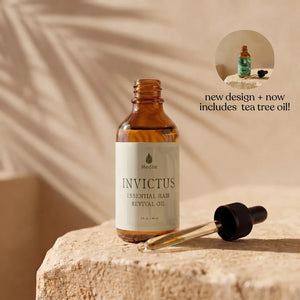
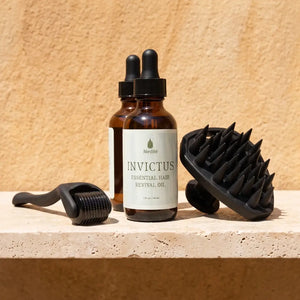
If you lean toward the natural side of this comparison, the formulation is what determines results. Medíté's Invictus Essential Hair Revival Oil is built around rosemary, the ingredient that went head-to-head with minoxidil, and adds peppermint, which outperformed minoxidil on follicle measures in its own research, plus tea tree for scalp health.
That combination is designed to cover circulation, follicle stimulation, and scalp balance in one step, with the studies behind each ingredient laid out on the Why It Works page. It is backed by more than 1,000 verified reviews at a 4.8-star average and a 90-day money-back guarantee, so testing the natural route carries little downside. U.S. orders over $45 ship free with a welcome gift.
Because the comparative studies paired the oil with daily scalp massage, the Medíté Starter Kit includes the tools to apply it the way the research did, which is what turns a good oil into real results.
Frequently asked questions
Is rosemary oil as effective as minoxidil?
In a six-month randomized trial, rosemary oil matched 2 percent minoxidil on hair count with less scalp itching. It was not compared to 5 percent minoxidil, and the evidence base for minoxidil overall is larger.
Does rosemary oil have fewer side effects than minoxidil?
Yes. In the head-to-head study, scalp itching was significantly more common with minoxidil, and rosemary oil avoids minoxidil's initial shedding phase and dependence on continuous use.
Can rosemary oil replace minoxidil?
For people with early thinning who prefer a natural approach, rosemary oil is a reasonable alternative. For advanced loss, or if you want the most proven option, minoxidil remains the benchmark, and the two can also be combined.
How long does rosemary oil take to work compared to minoxidil?
Rosemary oil generally shows results over three to six months, while minoxidil typically takes four to eight months to show growth and peaks at twelve to eighteen. Both require consistency.
The bottom line on rosemary oil vs minoxidil
Minoxidil is the more proven treatment, but it comes with more side effects and a lifelong commitment. Rosemary oil held its own against it in a direct trial, with a gentler profile and a natural approach that fits into lasting scalp care.
Neither is a miracle, and both reward patience and consistency. For anyone who wants an evidence-supported natural option, a well-formulated rosemary-based oil is one of the smartest places to start, and it is easy to add minoxidil later if you want to.
Sources
- Panahi Y, Taghizadeh M, Marzony ET, Sahebkar A. "Rosemary oil vs minoxidil 2% for the treatment of androgenetic alopecia: a randomized comparative trial." SKINmed. 2015;13(1):15-21. https://pubmed.ncbi.nlm.nih.gov/25842469/
- Oh JY, Park MA, Kim YC. "Peppermint Oil Promotes Hair Growth without Toxic Signs." Toxicological Research. 2014;30(4):297-304. https://link.springer.com/article/10.5487/TR.2014.30.4.297
- Olsen EA, et al. "A randomized clinical trial of 5% topical minoxidil versus 2% topical minoxidil and placebo in the treatment of androgenetic alopecia in men." Journal of the American Academy of Dermatology. 2002. https://pubmed.ncbi.nlm.nih.gov/12196747/
- International Society of Hair Restoration Surgery. "Effectiveness of 5% Minoxidil in Treating Male Pattern Hair Loss." https://ishrs.org/effectiveness-of-5-minoxidil-in-treating-male-pattern-hair-loss/