If you ask what the best natural hair growth oil is, the honest answer is that it is not a single ingredient. It is a well-formulated blend built around the oils with real clinical evidence behind them, led by rosemary, supported by peppermint and tea tree, and delivered consistently into a healthy scalp.
That is the short version. The longer version is worth your time, because the market is crowded with oils that lean on tradition and marketing rather than research, and knowing the difference is what separates a product that works from one that just smells nice.
This guide breaks down which natural oils actually have science behind them, what to look for in a premium formula, and how to use one so it delivers.
What makes a natural hair growth oil actually work?

A hair growth oil works by improving the environment your follicles grow in, not by forcing dead follicles back to life. The best ones do three things at once.
They support circulation to the scalp, which brings oxygen and nutrients to the follicles. They calm inflammation, which is one of the quiet drivers of thinning and follicle miniaturization. And they help maintain a balanced, healthy scalp where hair can move through its growth cycle without interference.
No topical oil overrides genetics or regrows a scalp that has been slick and bald for years. What a good oil does is give the follicles you still have the best possible conditions to grow thicker, stronger hair, and to hold onto the hair you have.
The most researched natural oils for hair growth

Not all natural oils are equal. Here is how the most popular ones actually stack up against the evidence.
Rosemary oil: the most clinically studied option
Rosemary oil has the strongest human evidence of any natural hair growth oil. In a randomized trial comparing rosemary oil to 2 percent minoxidil over six months in people with pattern hair loss, both groups saw a significant increase in hair count, and the two performed comparably. The rosemary group also reported less scalp itching than the minoxidil group.
The proposed mechanism is a combination of improved circulation and anti-inflammatory action, and rosemary's key compounds have been studied for their ability to interfere with the local effects of DHT, the hormone behind most thinning. We go deeper into the trial in does rosemary oil actually help with hair growth and what separates a quality product in finding the best rosemary oil for hair growth.
Peppermint oil: strong mechanistic evidence
Peppermint oil has impressive early research. In a controlled animal study, 3 percent peppermint oil produced more hair growth than 3 percent minoxidil, with significant increases in follicle number, follicle depth, and dermal thickness.
It also raised markers tied to the active growth phase, including IGF-1 and alkaline phosphatase. The evidence here is largely preclinical rather than large human trials, but the mechanism is promising, and peppermint's cooling sensation reflects the increased local blood flow it stimulates.
Tea tree oil: the scalp health specialist
Tea tree oil earns its place through scalp health rather than direct hair growth. Its main compound, terpinen-4-ol, has antimicrobial and antifungal activity, and in a controlled trial a 5 percent tea tree oil shampoo improved dandruff severity by 41 percent compared with 11 percent for placebo.
That matters because a flaky, inflamed, or microbially imbalanced scalp is a poor place to grow hair. Tea tree keeps the foundation clean and calm, which is why it belongs in a serious formula even though it is not a growth stimulant on its own.
Castor oil: a supporting player, not a hero
Castor oil is the most overhyped oil in this category. Despite its popularity, there are no strong human trials showing it directly regrows hair.
Its value is supportive. The ricinoleic acid it contains has anti-inflammatory properties, and its thick texture makes it a decent carrier that helps other actives stay on the scalp. It is a reasonable ingredient in a blend, but any product built entirely around castor oil is selling tradition, not evidence.
Pumpkin seed oil: promising, but the evidence is oral
Pumpkin seed oil deserves a mention because of one striking result: in a placebo-controlled trial, men taking 400 mg of pumpkin seed oil daily for 24 weeks saw a 40 percent increase in hair count, versus 10 percent for placebo. It appears to have mild 5-alpha-reductase-blocking activity, the same pathway that produces DHT.
The important caveat is that this study used an oral supplement, not an oil rubbed on the scalp, so it does not directly prove topical benefit. It is a reason to be interested, not a reason to expect the same from a topical alone.
Why a well-formulated blend beats any single oil

The reason the best natural hair growth oil is a blend rather than one ingredient is that these oils address different parts of the same problem.
Rosemary drives the circulation and anti-DHT angle. Peppermint adds growth-phase stimulation. Tea tree keeps the scalp environment healthy. A light carrier ties it together and helps everything absorb. Layer them and you cover circulation, inflammation, follicle stimulation, and scalp health in a single step, which no lone oil does.
This is also why concentration and formulation quality matter more than the length of the ingredient list. A blend with meaningful amounts of the researched actives will always outperform a bottle padded with cheap filler oils and a drop of rosemary for the label.
What to look for in a premium natural hair growth oil

When comparing products, a few criteria separate a genuine hair growth oil from a cosmetic one.
Look for evidence-backed actives listed high on the ingredient list, especially rosemary and peppermint, rather than buried at the bottom. Favor clean formulations without unnecessary silicones or heavy synthetic fragrance that can irritate the scalp. Check that the brand explains the reasoning and the research behind its formula rather than relying on before-and-after photos. And look for real customer validation and a return policy, which signal a company confident in its product.
Price is worth weighing too, though the cheapest option is rarely the best value, a point we cover in the best hair growth oils under $30.
How Medíté Invictus fits these criteria

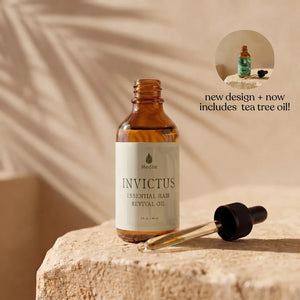
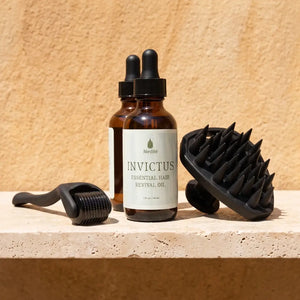
Medíté's Invictus Essential Hair Revival Oil was built around exactly this evidence. It combines rosemary and peppermint, the two oils with the most compelling hair growth research, with tea tree for scalp health and castor as a supportive carrier, rather than leaning on any single trendy ingredient.
The formulation reasoning and the studies behind each ingredient are laid out openly on the Why It Works page, which reflects the evidence-first approach this whole category tends to lack. It is backed by more than 1,000 verified customer reviews at a 4.8-star average and a 90-day money-back guarantee, so trying it carries little risk. U.S. orders over $45 ship free, and every order includes a welcome gift.
For people who want the complete routine rather than the oil alone, the Medíté Starter Kit pairs Invictus with the tools to work it into the scalp properly, since consistent application into a stimulated scalp is what turns a good oil into results.
How to use a natural hair growth oil for best results


Application is where most people leave results on the table. The goal is to get the oil onto the scalp, not just the hair.
Part your hair and apply a few drops directly to the scalp across thinning areas, then massage it in with your fingertips for a couple of minutes. That massage matters, because the mechanical stimulation supports circulation and helps the actives penetrate. Most people do best applying it several times a week and leaving it in, ideally overnight, before washing.
Consistency beats intensity every time. A small amount used regularly outperforms a heavy application you only remember occasionally. Our guide to getting thicker hair naturally puts the full routine in context.
How long does a natural hair growth oil take to work?


Expect to give it three to six months of consistent use before judging results, and there is a biological reason for that timeline.
Hair grows on a fixed cycle, and any support you provide has to wait for follicles to move through their resting and growth phases before new, healthier hair shows on the surface. Anyone promising visible regrowth in two weeks is selling a fantasy. Patience is part of the method, not a sign it is failing.
Are natural hair growth oils safe?

For most people, yes. Rosemary, peppermint, and tea tree oils are well tolerated when properly diluted in a formula, and they tend to cause less irritation than some medicated options.
The main precautions are simple. Do a small patch test first if you have sensitive skin, since essential oils can occasionally irritate. Undiluted essential oils should never be applied straight to the scalp, which is another reason a properly balanced blend is safer than a DIY mix. If you are pregnant or have a diagnosed scalp condition, check with a professional first.
Frequently asked questions about natural hair growth oils
What is the best natural oil for hair growth?
Rosemary oil has the strongest clinical evidence, having matched 2 percent minoxidil in a head-to-head trial. The best overall product is a blend that pairs rosemary with peppermint and tea tree for a combined effect on circulation, follicle stimulation, and scalp health.
Do natural hair growth oils really work?
The evidence-backed ones can genuinely support thicker, healthier hair and reduce shedding, especially early thinning. They work best as part of a consistent routine and are not a cure for advanced or genetic baldness.
Are natural oils as good as minoxidil?
Rosemary oil performed comparably to 2 percent minoxidil over six months in one trial, with less itching. Minoxidil has a larger body of evidence overall, but natural oils are a reasonable option for people who prefer a gentler, plant-based approach or want to combine the two.
Can hair growth oil regrow a receding hairline?
Oils can support follicles that are thinning but still active, which may help a receding hairline look fuller over time. They cannot regenerate follicles that have already been lost, which is why acting earlier gives better results.
The bottom line on choosing a natural hair growth oil
The best natural hair growth oil is an evidence-based blend, not a single miracle ingredient. Rosemary leads on human research, peppermint adds strong follicle-stimulating potential, and tea tree keeps the scalp healthy enough for any of it to work. Castor and other oils play supporting roles at best.
Choose a formula that puts the researched actives front and center, apply it to the scalp consistently, and give it a few months. Do that, and a natural oil becomes one of the most sensible, low-risk steps you can take toward fuller hair.
Sources
- Panahi Y, et al. "Rosemary oil vs minoxidil 2% for the treatment of androgenetic alopecia: a randomized comparative trial." SKINmed. 2015;13(1):15-21. https://pubmed.ncbi.nlm.nih.gov/25842469/
- Oh JY, Park MA, Kim YC. "Peppermint Oil Promotes Hair Growth without Toxic Signs." Toxicological Research. 2014;30(4):297-304. https://link.springer.com/article/10.5487/TR.2014.30.4.297
- Satchell AC, et al. "Treatment of dandruff with 5% tea tree oil shampoo." Journal of the American Academy of Dermatology. 2002;47(6):852-855. https://pubmed.ncbi.nlm.nih.gov/12451368/
- Cho YH, et al. "Effect of Pumpkin Seed Oil on Hair Growth in Men with Androgenetic Alopecia: A Randomized, Double-Blind, Placebo-Controlled Trial." Evidence-Based Complementary and Alternative Medicine. 2014. https://www.ncbi.nlm.nih.gov/pmc/articles/PMC4017725/