You notice the flakes on your shoulders first. Then the itch. Then, somewhere in the back of your mind, a quieter worry: is all this dandruff actually costing me hair?
It is one of the most common scalp questions out there, and the answers you find are usually either dismissive ("dandruff is harmless") or alarmist ("flaking means you are going bald"). Neither is quite right.
The real relationship between dandruff and hair loss is more specific and more useful to understand, because once you know what is actually happening on your scalp, you know exactly what to fix. Here is the full picture.
Does dandruff cause hair loss, or does it just make thinning look worse?

Start with the reassuring part. Ordinary dandruff, the mild flaking most people deal with, does not directly kill hair follicles or cause permanent baldness. You are not losing your hair simply because your scalp sheds some skin.
But that is not the whole story, and this is where most articles stop too early. Dandruff and the inflammation that often comes with it can absolutely contribute to hair shedding and make existing thinning worse. The flakes themselves are a symptom of a scalp environment that, left unchecked, is not ideal for growing strong hair.
So the honest answer is this: dandruff rarely causes hair loss on its own, but the conditions that produce dandruff can. The distinction matters, because treating the scalp usually resolves the shedding too.
Dandruff versus seborrheic dermatitis: why the difference decides everything

People use "dandruff" as a catch-all, but dermatologists see a spectrum, and where you fall on it determines how much your hair is at risk.
Plain dandruff is the mild end. You get white or grayish flakes and some itching, but little to no redness or irritation of the skin itself. This form is mostly a cosmetic nuisance and poses little threat to your follicles.
Seborrheic dermatitis is the inflammatory end of the same spectrum. Here the scalp becomes genuinely inflamed, with redness, greasy yellowish scales, and more intense itching. This is the version that matters for your hair, because inflammation is the mechanism that interferes with growth. Increased shedding is much more strongly linked to seborrheic dermatitis than to simple flaking.
If your scalp is only dusty with flakes, your hair is probably fine. If it is red, inflamed, and persistently irritated, that is the situation worth taking seriously.
What actually causes dandruff, and why it is not dry scalp

The most common myth is that dandruff comes from a dry scalp, so people reach for less washing and more oil. That often makes it worse, because the real driver is usually the opposite of dryness.
Most dandruff traces back to a yeast called Malassezia, which lives on nearly everyone's scalp as a normal resident. It feeds on the oils your scalp produces. As it breaks down sebum, it releases byproducts, most notably a fatty acid called oleic acid. In people whose scalps are sensitive to it, oleic acid triggers irritation, and the skin responds by speeding up its shedding of cells. Those clumped-together dead cells are the flakes you see.
This is why dandruff tends to be worse on oilier scalps, and why it often flares alongside stress, hormonal shifts, and certain seasons. If you have wondered why your scalp gets greasy so fast in the first place, that oil supply is the same fuel the yeast depends on, a connection we cover in the science behind an oily scalp.
Understanding this changes the whole approach. Dandruff is not a moisture problem you solve with heavier oils. It is a microbial and inflammatory problem you solve by calming the scalp and keeping that yeast in check.
How scalp inflammation interferes with the hair growth cycle

To see how flaking connects to shedding, you have to look below the surface at the follicle itself.
Every hair grows on a cycle: a long active growth phase, a short transition, and a resting phase before the old hair falls and a new one starts. A healthy scalp keeps the vast majority of your follicles in that active growth phase at any given time. Chronic inflammation disrupts the timing.
When the scalp stays inflamed, it pushes more follicles out of the growth phase and into resting and shedding earlier than they should. The result is more hairs falling and fewer actively growing to replace them, which reads on your head as diffuse thinning.
Inflammation also feeds directly into the process behind genetic hair loss. The same inflammatory signaling involved in scalp irritation overlaps with the pathways that drive follicle miniaturization, the gradual shrinking of follicles that makes each new hair finer than the last. One of the inflammatory proteins in this story, IL-6, is also a tool that DHT uses to suppress follicles, which is part of why a chronically inflamed scalp is a worse environment for anyone already prone to thinning. Our explainer on what DHT is and how it shrinks follicles breaks that hormone down in detail.
In short, dandruff is a visible sign that your scalp is irritated, and an irritated scalp is not a neutral place for hair to grow.
The scratching problem: breakage that looks like hair loss

There is a second, more mechanical way dandruff costs you hair, and it has nothing to do with follicles at all.
Dandruff itches, and scratching feels like relief. But repeated vigorous scratching physically damages hair. Nails snap strands mid-shaft and weaken the point where the hair anchors into the scalp. The hair you find after scratching is often broken, not shed from the root.
This matters because breakage and true shedding look similar in the sink but mean very different things. Breakage is surface damage you can stop almost immediately by calming the itch. It also tends to be worse when hair is wet and most fragile, so scratching a flaky scalp in the shower is especially rough on it.
The takeaway is practical: if you get the itch under control, you remove a real source of hair loss even before the follicles themselves recover.
Can dandruff make genetic hair thinning worse?
This is the question that worries people most, and the answer is nuanced but important.
Dandruff does not create male or female pattern hair loss. That is driven mainly by genetics and hormones. But a flaky, inflamed scalp can act as an accelerant on top of a genetic tendency. If your follicles are already under pressure from DHT and slowly miniaturizing, adding chronic inflammation to the mix gives them one more thing working against them.
Think of it as two separate problems that stack. The genetic component is one issue. The scalp environment is another. You may not be able to change your genes, but the scalp environment is very much within your control, and improving it removes a burden your follicles do not need. This is exactly why long-term scalp care is worth the effort even for people whose thinning is primarily hereditary.
What the research says about treating dandruff for healthier hair
Here is the encouraging part, and it is backed by real data rather than hope. When you treat the dandruff, hair measurements tend to improve too.
In a study of 150 men who had both dandruff and early androgenetic hair shedding, researchers compared three common anti-dandruff ingredients used two to three times a week for six months: ketoconazole, piroctone olamine, and zinc pyrithione. All three reduced hair shedding, by roughly 17, 16, and 10 percent respectively, and all three increased the proportion of hairs in the active growth phase. Ketoconazole, which is both antifungal and anti-inflammatory, also increased the diameter of the hair shafts, meaning thicker individual strands.
Read that carefully, because the mechanism is the point. These are anti-dandruff treatments, not dedicated hair growth drugs, yet simply calming the yeast and the inflammation improved growth-phase hair counts and shaft thickness. That is strong evidence that the scalp environment itself influences how well hair grows.
Plant-derived options have data too. In a controlled trial of 126 people with dandruff, a 5 percent tea tree oil shampoo used daily for four weeks improved dandruff severity by 41 percent, compared with 11 percent for the placebo. Tea tree oil's main active compound, terpinen-4-ol, works by disrupting the cell membranes of the Malassezia yeast, targeting the same root cause the medicated shampoos do.
Is dandruff-related hair loss permanent?
For the vast majority of people, no, and this is the most important thing to hold onto.
Because the shedding is driven by inflammation and irritation rather than by follicles being destroyed, it is usually reversible. Once you bring the dandruff and scalp inflammation under control, the follicles recover and hair grows back on its normal cycle. The follicles were being suppressed, not killed.
The rare exception is severe, long-neglected seborrheic dermatitis that has been allowed to inflame the scalp for years, which can in unusual cases lead to scarring and more lasting loss. That is uncommon and avoidable, and it is the best argument for not ignoring a chronically inflamed, itchy scalp. Treated reasonably early, dandruff-related shedding is a temporary problem.
How to get rid of dandruff and protect your hair at the same time
The goal is to control the yeast, calm the inflammation, and stop the scratching, all without stripping or irritating the scalp further. A few principles do most of the work.
Reach for an active ingredient, not just any shampoo. Zinc pyrithione, ketoconazole, piroctone olamine, and selenium sulfide all target Malassezia and its irritation, and the research above shows they help both the flaking and the hair metrics. Let the lather sit on the scalp for a few minutes so the active has time to work rather than rinsing immediately.
Do not under-wash a flaky scalp. Since the problem is fed by oil and yeast rather than dryness, letting sebum build up usually makes dandruff worse, not better. Regular, gentle cleansing keeps the fuel supply and the yeast population down.
Resist the scratch. Keeping your nails off an itchy scalp prevents the breakage that masquerades as hair loss. Treating the underlying irritation is what actually stops the itch, so the two goals reinforce each other.
Be gentle overall. Very hot water, harsh sulfates, and aggressive towel-drying all irritate an already sensitive scalp. A calmer scalp flakes less and grows hair better, a theme that runs through our guide to getting thicker hair naturally.
Where scalp oils help with dandruff, and where they can backfire
Because oil and dandruff are linked, this deserves an honest answer rather than a sales pitch. Not every oil is good for a flaky scalp, and getting this wrong is a common mistake.
Heavy, purely occlusive oils applied generously to a dandruff-prone scalp can sometimes make things worse, because Malassezia feeds on certain lipids and a thick layer of oil can give it more to work with. This is why slathering coconut or olive oil on an inflamed, flaky scalp is not reliable advice.
What does have evidence is targeted, antimicrobial botanicals used sensibly. Tea tree oil, as the trial above showed, actively works against the yeast driving dandruff rather than feeding it. That is a meaningful difference. The value comes from what the oil does biologically, not from simply coating the scalp.
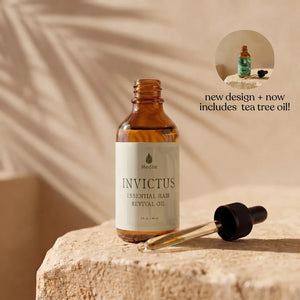
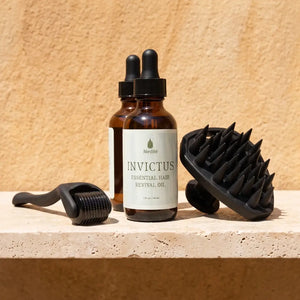
This is the logic behind how our Invictus Essential Hair Revival Oil is built. It pairs tea tree with rosemary in a formula meant to support a calmer, healthier scalp environment rather than just sit on top of it, and it is designed to be used deliberately rather than drowned on. You can see the reasoning and the ingredient evidence on our Why It Works page. If you would rather approach scalp health as a full routine, the Medíté Starter Kit pairs the oil with tools to work it into the scalp properly, and U.S. orders over $45 ship free.
Use these as part of a scalp-first strategy, not as a substitute for a medicated shampoo if you have genuine seborrheic dermatitis. The two approaches work well together: control the yeast, then support the scalp.
The bottom line on dandruff and hair loss
Dandruff by itself is rarely the villain. What matters is the inflammation and irritation underneath it, which can push hair into shedding, worsen existing genetic thinning, and invite the scratching that breaks strands. The good news threaded through all of it is that this is one of the most fixable scalp situations there is.
Calm the yeast, reduce the inflammation, stop scratching, and the follicles almost always recover. A flake-free scalp is not just about clean shoulders. It is one of the simplest foundations for hair that grows in thicker and stays put.
Sources
- Piérard-Franchimont C, et al. "Nudging hair shedding by antidandruff shampoos. A comparison of 1% ketoconazole, 1% piroctone olamine and 1% zinc pyrithione formulations." International Journal of Cosmetic Science. 2002;24(5):249-256. https://onlinelibrary.wiley.com/doi/abs/10.1046/j.1467-2494.2002.00145.x
- Satchell AC, et al. "Treatment of dandruff with 5% tea tree oil shampoo." Journal of the American Academy of Dermatology. 2002;47(6):852-855. https://pubmed.ncbi.nlm.nih.gov/12451368/
- Borda LJ, Wikramanayake TC. "Seborrheic Dermatitis and Dandruff: A Comprehensive Review." Journal of Clinical and Investigative Dermatology. 2015. https://www.ncbi.nlm.nih.gov/pmc/articles/PMC4852869/