You can eat well, use the right products, and manage your stress, but if you are running on five hours of sleep a night, you may be quietly working against your own hair. Sleep is the one input people almost never connect to thinning, and it turns out to be one of the most biologically important.
The link is not a wellness cliché. Your hair follicles are directly wired into the same systems that sleep controls, right down to having their own internal clock. Here is what the science actually shows about how sleep affects your hair, and what to do about it.
Does lack of sleep cause hair loss?

Poor sleep does not make you go bald overnight, but chronic sleep deprivation genuinely contributes to hair loss. It does this by disrupting the hormones and cellular rhythms that follicles depend on, and by amplifying the same factors that drive genetic thinning.
Think of sleep as the maintenance window your body uses to repair tissue, regulate hormones, and reset its internal clock. Cut that window short night after night, and your hair is one of the first non-essential systems to feel the strain. The effect is gradual and easy to miss, which is exactly why it is so overlooked.
How sleep deprivation disrupts your hair

The damage runs through three hormones that sleep controls, each with a direct line to your follicles.
Cortisol, the stress hormone that rises when you skip sleep
Sleep loss drives up cortisol, your primary stress hormone. Even partial sleep restriction has been shown to significantly raise evening cortisol levels.
That matters because elevated stress hormones push hair follicles out of their growth phase and into resting and shedding earlier than they should. Chronically high cortisol is one of the clearest hormonal paths to increased shedding, and short sleep keeps it elevated. It is the same mechanism behind stress-related hair loss, just triggered from a different direction.
Growth hormone, released only in deep sleep
During the deepest stages of sleep, your body releases growth hormone, which is central to repairing and regenerating tissue, including hair follicles.
The catch is that you only reach those deep stages with enough uninterrupted sleep. Cut your night short or fragment it with poor quality sleep, and you miss the window when this repair hormone peaks. Over time, less restoration means follicles that are less equipped to sustain healthy growth.
Melatonin, which does more for hair than help you sleep
Melatonin, the hormone that rises in darkness to make you sleepy, also has a direct role in hair. Follicles carry melatonin receptors, and melatonin acts as a powerful antioxidant that protects them from oxidative stress.
The evidence here is striking. In a study of women with pattern and diffuse hair loss, applying a topical melatonin solution for six months significantly increased the proportion of hairs in the active growth phase. Poor sleep suppresses your natural melatonin, removing a layer of protection your follicles quietly rely on.
Your hair follicles have their own body clock

Here is the part that surprises even people who follow hair science closely. Your follicles do not just respond to sleep hormones. They contain their own circadian clock.
The same clock genes that run your sleep-wake cycle, with names like BMAL1, PER1, and CLOCK, are active inside the hair follicle, in the matrix and dermal papilla cells that control growth. These genes rise and fall in step with the hair cycle and help regulate when follicle cells divide and push growth forward.
When researchers disrupted these clock genes in animals, the follicles showed a clear delay in entering the active growth phase, because the cells were not dividing on schedule. Since sleep deprivation and irregular sleep alter clock gene expression throughout the body, chronically disrupted sleep can throw off the very timing system your follicles use to grow. Your hair, in a real biological sense, keeps time.
What kind of hair loss does poor sleep cause?

Sleep-related hair loss shows up in two ways, depending on your underlying situation.
The most direct is increased shedding, the diffuse, all-over thinning of telogen effluvium, driven mainly by the cortisol spike and the loss of restorative sleep. This type is usually temporary and improves once sleep is restored.
The second is subtler. If you are already genetically prone to pattern hair loss, poor sleep acts as an accelerant, amplifying the hormonal and inflammatory pressures that drive DHT-related thinning. It does not create genetic hair loss, but it can speed it along. Our explainer on what DHT is covers that underlying process, and our overview of common causes of thinning puts sleep alongside the other contributors.
Can better sleep help your hair grow back?

In most cases, yes, especially when poor sleep was a real contributor. Because sleep-related shedding works through reversible mechanisms, restoring consistent, quality sleep lowers cortisol, restores your growth hormone and melatonin rhythms, and lets your follicles' internal clock resynchronize.
This will not regrow follicles lost to advanced genetic baldness, but it removes a hidden brake on the hair you still have. For many people, fixing chronically bad sleep is one of the more impactful and completely free changes they can make.
How much sleep does your hair actually need?

Aim for seven to nine hours of quality sleep per night, the range most adults need for full hormonal and cellular recovery.
Quality matters as much as quantity here. Because growth hormone release and deep restoration depend on reaching the deeper sleep stages, fragmented or restless sleep can shortchange your follicles even if you spend enough hours in bed. Consistency counts too, since your circadian clock, and by extension your follicles' clock, runs best on a regular schedule.
Sleep habits that protect your hair

A few practical changes support the hormonal rhythms your hair depends on. Keep a consistent sleep and wake time, even on weekends, to stabilize your circadian clock. Sleep in a genuinely dark room, since darkness is what cues your natural melatonin. Get bright light exposure in the morning to anchor your rhythm, and cut back on screens and caffeine late in the day, both of which suppress melatonin and delay deep sleep.
One bonus that has nothing to do with hormones: what you sleep on. A smooth pillowcase, like silk or satin, creates less friction against your hair through the night than cotton, which can help reduce mechanical breakage over time. It is a small edge, but an easy one.
Where scalp care fits into the picture

Better sleep repairs your hair from the inside by restoring its hormonal and cellular environment. Topical scalp care works from the outside, supporting circulation and a healthy scalp so recovering follicles have the best place to grow.
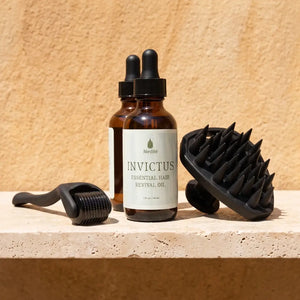
The two complement each other, which is why a simple scalp routine pairs well with fixing your sleep rather than replacing it. Ingredients like rosemary and peppermint support scalp circulation, the reasoning behind our Invictus Essential Hair Revival Oil and the Medíté Starter Kit, with the evidence laid out on our Why It Works page. Feed the follicle with rest, then support it at the surface.
How long until better sleep shows in your hair?
Give it three to six months before expecting visible change, and understand the delay is the hair cycle, not a sign it is not working.
Once your sleep and hormones stabilize, follicles still have to move through their resting phase and re-enter growth before new hair reaches the surface, a timeline we explain in why hair growth takes so long. The improvements happen quietly beneath the scalp well before you see them.
Frequently asked questions
Can lack of sleep really cause hair loss?
Yes. Chronic sleep deprivation raises cortisol, reduces growth hormone and melatonin, and disrupts the follicle's internal clock, all of which can increase shedding and accelerate genetic thinning.
Will my hair grow back if I fix my sleep?
Usually, if poor sleep was a contributor. Sleep-related shedding works through reversible mechanisms, so restoring quality sleep can bring shedding back to normal over several months. It will not reverse advanced genetic baldness.
Does melatonin help with hair loss?
Melatonin has antioxidant effects in the follicle, and a topical melatonin solution increased growth-phase hairs in one study. Its role in hair is one reason healthy natural melatonin from good sleep matters.
How many hours of sleep do I need for healthy hair?
Seven to nine hours of consistent, quality sleep gives your body the hormonal and cellular recovery your follicles depend on.
The bottom line on sleep and hair loss
Sleep is not a minor factor in hair health. It regulates the cortisol, growth hormone, and melatonin your follicles rely on, and it keeps the internal clock inside each follicle running on time. Skimp on it consistently and you increase shedding and hand genetic thinning an accelerant.
The fix is refreshingly simple and free. Protect seven to nine hours of quality, regular sleep, support your scalp on the outside, and give the hair cycle a few months. It may be the most underrated thing you can do for your hair.
Sources
- Fischer TW, et al. "Topical melatonin for treatment of androgenetic alopecia." International Journal of Trichology. 2012;4(4):236-245. https://www.ncbi.nlm.nih.gov/pmc/articles/PMC3573963/
- Lin KK, Kumar V, Geyfman M, et al. "Circadian Clock Genes Contribute to the Regulation of Hair Follicle Cycling." PLOS Genetics. 2009;5(7):e1000573. https://www.ncbi.nlm.nih.gov/pmc/articles/PMC2705795/
- Leproult R, et al. "Sleep loss results in an elevation of cortisol levels the next evening." Sleep. 1997;20(10):865-870. https://pubmed.ncbi.nlm.nih.gov/9415946/