Every few months a hair loss method goes viral, and most of them deserve the skepticism. Microneedling, also called dermarolling, is the rare exception. It sounds strange, rolling a device covered in tiny needles across your scalp, but it has some of the most striking clinical results in the entire field of hair regrowth.
So does microneedling actually work for hair growth, or is it another trend? The evidence here is unusually strong, and it points to one clear conclusion: microneedling works best not on its own, but as a multiplier for whatever you are already using. Here is what the research shows and how to do it properly.
Does microneedling actually work for hair growth?

Yes, and the evidence is more convincing than for almost any other at-home method. Controlled studies show that microneedling significantly increases hair count, especially when combined with a topical treatment applied to the scalp.
The important nuance is that microneedling is an amplifier. It creates the conditions for growth and dramatically improves how well topical treatments work, rather than acting as a standalone cure. Used that way, it is one of the most effective non-drug tools available.
What the landmark microneedling study found

The reason microneedling earned serious attention comes down to one well-designed 2013 trial, and the numbers are hard to ignore.
Researchers took 100 men with pattern hair loss and split them into two groups for twelve weeks. One group used 5 percent minoxidil twice daily. The other used the same minoxidil plus a weekly microneedling session with a 1.5 mm dermaroller.
The difference was dramatic. The microneedling group gained an average of 91 additional hairs per measured area, compared with just 22 in the minoxidil-only group, roughly a fourfold advantage. Even more telling, 82 percent of the microneedling group reported more than 50 percent improvement in their hair, versus about 4.5 percent of the group using minoxidil alone.
Later controlled studies have repeated the pattern: adding microneedling to a topical routine consistently outperforms the topical by itself. That is a large, reproducible effect, which is rare in this space.
How microneedling stimulates hair growth

The mechanism sounds counterintuitive. You are creating tiny, controlled injuries in the scalp, and the growth comes from how your body responds to them.
Those micro-injuries trigger the skin's wound-healing cascade. In response, the scalp releases a surge of growth factors, including platelet-derived growth factor and vascular endothelial growth factor, the same signals involved in building blood supply and activating follicles. The process also stimulates Wnt signaling and dermal stem cells, pathways tied directly to the active growth phase of the hair cycle.
There are two practical payoffs. First, that growth-factor surge stimulates the follicles themselves. Second, the microchannels the needles create temporarily let topical treatments penetrate far deeper than they normally could, which is why microneedling supercharges anything you apply afterward. A calmer, better-circulated scalp is a better growing environment, which is the same principle behind supporting scalp health and hair density.
Microneedling and rosemary oil, and why they work together

The studies pairing microneedling with rosemary oils for hair growth worked so well precisely because the two do different jobs. Rosemary stimulates the follicle and prolongs the growth phase, while microneedling both adds its own growth-factor stimulation and helps the rosemary oil (or other topical hair growth product) absorb.
This is also why microneedling has become popular among people who did not respond to topical rosemary oil for hair growth alone. By improving delivery and adding a second mechanism, it can push results past what the drug achieved on its own.
What needle depth and frequency actually work

Getting the details right matters, because too aggressive is worse than too gentle. The research points to a fairly specific sweet spot.
For the scalp, needle depths of 1.0 to 1.5 mm are where the positive trials landed. Shorter needles may be too shallow to trigger the full response, while going deeper raises the risk of damage without added benefit.
Frequency is once a week, not daily. The scalp needs time to complete its healing and growth-factor response between sessions, and over-rolling only causes irritation and inflammation that work against you. Weekly, consistent sessions beat frequent, aggressive ones every time.
Can you use microneedling with rosemary oil instead of minoxidil?

This is where microneedling gets interesting for people who prefer a natural approach. The mechanism that makes microneedling boost minoxidil absorption applies to any well-formulated topical, including evidence-backed botanical oils.
Rosemary oil, which matched 2 percent minoxidil in a head-to-head trial, and peppermint oil, which outperformed minoxidil on follicle measures in its own study, are natural candidates to pair with microneedling. The needling enhances delivery of the active compounds while adding its own growth-factor stimulation. We cover the oil evidence in does rosemary oil actually help with hair growth.
One important timing note: do not apply an active oil or minoxidil immediately after needling. The freshly opened channels increase absorption and the risk of irritation, so it is safer to apply your topical the next day and keep the scalp clean right after a session.
How to microneedle your scalp safely
Done carefully, at-home microneedling is low-risk. A few rules keep it that way.
Start clean. Disinfect the dermaroller before and after every use, and never share it. Work on a clean, dry scalp, and roll gently in several directions across thinning areas, using light pressure rather than pressing hard. A little pinkness is normal, but you should not be drawing significant blood or causing pain.
Keep sessions to once a week, and give the scalp a day before applying any active topical. Skip microneedling entirely if you have an active scalp infection, inflamed acne, or a condition like psoriasis flaring on the scalp. If you are unsure, check with a dermatologist first.
How long does microneedling take to show results?
Plan on three to six months of weekly sessions before judging results, in line with the clinical trials, which ran twelve weeks and beyond.
The timeline is set by the hair cycle. New growth has to move through the follicle's phases before it shows on the surface, so patience is part of the method. Consistency over months is what produced the results in the studies, not any single dramatic session. Our guide to why hair growth takes so long explains the underlying timing.
Is microneedling for hair growth safe?
For most people, at-home scalp microneedling at appropriate depths is safe and well tolerated. The most common effects are temporary redness, mild tenderness, and slight flaking, all of which settle quickly.
The real risks come from doing it wrong: needles that are too long, rolling too often, poor hygiene that invites infection, or applying strong actives onto a freshly needled scalp. Follow sensible depth, weekly frequency, and clean technique, and microneedling stays firmly in the low-risk category.
Where Medíté fits in
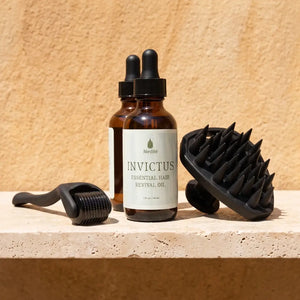
Microneedling and a quality topical are a package deal, which is exactly how the Medíté Starter Kit is built. It pairs a dermaroller with the Invictus Essential Hair Revival Oil, a rosemary and peppermint formula chosen because those are the two most researched natural oils for hair growth, so you get the mechanical stimulation and an evidence-backed topical to deliver into the scalp.
The reasoning and the studies behind the formula are laid out on the Why It Works page, and the system is backed by more than 1,000 verified reviews at a 4.8-star average and a 90-day money-back guarantee. U.S. orders over $45 ship free with a welcome gift. Use the roller weekly, apply the oil on the following days, and you are running a routine modeled on what the research actually tested.
Frequently asked questions about microneedling for hair
Does dermarolling really regrow hair?
Controlled studies show microneedling significantly increases hair count, especially alongside a scalp topical, where it produced roughly four times the regrowth of the topical alone. It works best on thinning-but-active follicles, not fully bald areas.
What size dermaroller is best for hair growth?
Research supports 1.0 to 1.5 mm needle depths for the scalp. Shorter needles may be too shallow, and longer ones add risk without clear benefit.
How often should you microneedle your scalp?
Once a week. The scalp needs time to complete its healing and growth-factor response between sessions, and more frequent rolling causes irritation that undermines results.
Can I use microneedling with rosemary oil?
Yes. Microneedling enhances the absorption of any well-formulated topical, including rosemary and peppermint oils. Apply the oil the day after a session rather than immediately after, to avoid irritation.
Is microneedling better than minoxidil?
They are best combined rather than compared. Microneedling amplifies minoxidil and other topicals, and it can help people who did not respond to a topical on its own.
The bottom line on microneedling for hair growth
Microneedling is one of the few viral hair methods that holds up under real scrutiny. By triggering the scalp's healing response and dramatically improving how well topicals absorb, it can multiply the results of a good routine.
Keep the needles at 1.0 to 1.5 mm, roll once a week, pair it with an evidence-backed topical applied the next day, and give it several months. Done right, it is one of the most powerful at-home tools for getting more out of everything else you do for your hair.
Sources
- Dhurat R, Sukesh M, Avhad G, et al. "A Randomized Evaluator Blinded Study of Effect of Microneedling in Androgenetic Alopecia: A Pilot Study." International Journal of Trichology. 2013;5(1):6-11. https://pubmed.ncbi.nlm.nih.gov/23960389/
- Jha AK, et al. "A Randomized Controlled, Single-Observer Blinded Study to Determine the Efficacy of Topical Minoxidil plus Microneedling versus Topical Minoxidil Alone in the Treatment of Androgenetic Alopecia." Journal of the American Academy of Dermatology. 2019. https://pubmed.ncbi.nlm.nih.gov/30886475/
- Panahi Y, et al. "Rosemary oil vs minoxidil 2% for the treatment of androgenetic alopecia: a randomized comparative trial." SKINmed. 2015;13(1):15-21. https://pubmed.ncbi.nlm.nih.gov/25842469/