You go through a brutal few months. A loss, a deadline stretch, an illness, a move. Then the shedding starts, and suddenly your brush and your shower drain look alarming.
The timing feels obvious, but is stress really pulling your hair out, or is that just something people say? The science here is unusually clear, and it is worth understanding, because stress-related hair loss behaves very differently from genetic thinning.
Does stress cause hair loss, or is that a myth?
It is real. Significant physical or emotional stress can trigger a type of shedding called telogen effluvium, where an unusually large share of your follicles get pushed into their resting phase at once and shed a few months later.
This is different from thinking a bad week will make you go bald. It takes a genuine shock to the system, and the good news buried in that fact is that this kind of loss is usually temporary.
What stress actually does to your hair follicles

Every follicle cycles between growing, resting, and shedding. Stress interferes with that cycle at the cellular level, and a 2021 Harvard study published in Nature showed exactly how.
Researchers found that a stress hormone, corticosterone (the mouse version of human cortisol), acts on the dermal papilla, the control center at the base of each follicle. Sustained high levels of it stop the papilla from releasing a molecule called Gas6, which is what normally wakes follicle stem cells up and starts a new growth phase.
In other words, stress hormones keep follicles stuck in resting mode instead of regrowing. When the researchers restored Gas6, hair growth resumed even in stressed mice. That is a precise, cellular explanation for something people have described anecdotally for generations.
Why the shedding shows up months after the stress

This is the part that confuses everyone. The hair usually falls two to three months after the stressful event, not during it.
That delay is just the hair cycle playing out. Stress forces follicles into the resting phase, and resting hairs are not released immediately. They hang on for weeks before finally shedding. By the time you notice the fallout, the crisis that caused it is often already behind you, which is why the connection is so easy to miss. Our breakdown of why hair growth takes so long explains the timing of the cycle in more depth.
Telogen effluvium versus pattern hair loss: how to tell them apart
The distinction matters because the two need completely different responses.
Stress shedding is diffuse. You lose hair evenly across the whole scalp, often noticing more strands everywhere rather than a specific bald patch, and it tends to follow an identifiable trigger. Genetic hair loss is patterned. It targets the hairline, temples, and crown, and it comes on gradually over years, driven by DHT slowly shrinking those follicles rather than a sudden shock. If you are not sure which you are dealing with, our guide to what DHT is and how it drives thinning lays out the hormonal version.
One clue: telogen effluvium usually improves once the stressor passes. Pattern loss keeps progressing without intervention.
Will your hair grow back after stress?


In most cases, yes. Because the follicles are paused rather than destroyed, they can restart once cortisol levels settle and the trigger resolves. Regrowth typically begins within a few months, though it can take six to twelve months to fully recover its former density.
The catch is that ongoing, unresolved stress keeps the follicles suppressed. The single most important step is addressing the source, whether that is rest, recovery from an illness, better sleep, or managing a chronic stressor. There is no topical that outruns a nervous system stuck in overdrive.
How to support regrowth while your hair recovers

Once the stressor is easing, the goal is simply to give follicles the healthiest possible environment to switch back on. Eat enough protein and iron, since deficiencies compound shedding, sleep well, and be gentle with fragile regrowing hair.
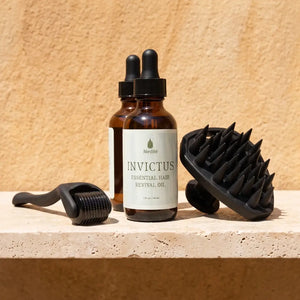
Scalp care helps here too, because a calm, well-circulated scalp is a better place for paused follicles to reactivate. Keeping inflammation down and blood flow up supports the same cycle stress disrupted, which is the thinking behind our Invictus Essential Hair Revival Oil and the routine in the Medíté Starter Kit. You can see the ingredient reasoning on our Why It Works page. None of this overrides the need to resolve the stress itself, but it gives recovering hair a head start.
The bottom line on stress and hair loss
Stress genuinely causes hair loss, but through a reversible mechanism: hormones pause your follicles rather than kill them. Shedding lags the stress by a couple of months, spreads across the whole scalp, and usually recovers once life settles down. Fix the root cause first, support the scalp second, and give the cycle the months it needs to catch up.
Sources
- Choi S, Zhang B, Hsu YC, et al. "Corticosterone inhibits GAS6 to govern hair follicle stem-cell quiescence." Nature. 2021;592:428-432. https://pubmed.ncbi.nlm.nih.gov/33790465/
- Harvard Department of Stem Cell and Regenerative Biology. "How chronic stress leads to hair loss." https://hscrb.harvard.edu/news/how-chronic-stress-leads-to-hair-loss/
- National Institute on Aging. "How stress causes hair loss." https://www.nia.nih.gov/news/how-stress-causes-hair-loss