

Every autumn, the same quiet panic spreads. You are running your hands through your hair, clearing the shower drain, or noticing strands on your pillow, and it suddenly feels like too much. If your shedding seems to spike in late summer and fall, you are not imagining it, and you are far from alone.
Seasonal hair shedding is real, it is backed by research, and for most people it is completely harmless. Here is what is actually happening, how to tell it apart from something more serious, and what to do about it.
Is it normal to shed more hair in the fall?

Yes. Many people shed noticeably more hair in late summer and autumn than at other times of year, and it is a normal, temporary pattern rather than a sign you are going bald.
On a typical day it is normal to lose somewhere in the range of 50 to 100 hairs, and more on wash days. During a seasonal shed, that number climbs for a few weeks before settling back down on its own. The hair you lose is generally replaced, which is what separates this from true, progressive hair loss.
What the research says about seasonal shedding

This is not folklore. Researchers have measured it. A well-known study by Kunz and colleagues followed healthy women over several years and found that the proportion of hair follicles in the resting phase peaked in summer. Because a resting hair sheds roughly a few months after it enters that phase, that summer peak translates into a wave of shedding in the autumn.
Earlier work by Randall and Ebling reported a similar seasonal rhythm, with hair shedding tending to reach its highest point in autumn. In other words, two separate lines of research point to the same conclusion: hair follicles follow a seasonal cycle, and fall is when the shedding shows up.
Why your body sheds more hair in autumn

The leading explanation is evolutionary. The theory is that we hold onto more hair through the summer, when a fuller head of hair helps shield the scalp from strong sun. As that protective need fades heading into cooler months, those hairs are released, producing the autumn shed.
It is the human echo of the seasonal coats you see in other mammals. Your follicles are responding to a rhythm older than any hair product, which is part of why the timing is so consistent year to year.
What people notice

Real experiences make this less scary than the numbers alone, so this section is where your genuine customer voices belong.
[Insert a real verified review here from a customer who experienced seasonal shedding and what helped, with first name and last initial as it appears in your reviews.]
[Insert a second real verified review here, ideally one describing the reassurance of understanding the cause or sticking with a scalp routine through a shed.]
Paste me a few of your actual reviews and I will place them here cleanly, keeping the wording exactly as written.
How much fall shedding is normal, and how much is too much?

The line comes down to how much, how long, and whether it recovers. A seasonal shed is a temporary bump. You notice more hair for a few weeks, then it eases back to your normal baseline, and your overall density holds steady.
It becomes worth attention when heavy shedding drags on well beyond a couple of months, when you are losing hair in visibly larger amounts day after day, or when your hair is not growing back to its usual fullness. Sustained heavy shedding like that is called telogen effluvium, and while it is often still reversible, it usually has a specific trigger worth identifying, from stress to a nutritional gap.
Seasonal shedding versus real hair loss

Telling the two apart is mostly about pattern and permanence. Seasonal shedding is diffuse, spread evenly across the whole scalp, temporary, and followed by regrowth. Pattern hair loss is different. It is gradual, targets specific areas like the hairline and crown, and progresses over years rather than arriving as a seasonal wave, driven by DHT slowly shrinking sensitive follicles. Our explainer on what DHT is covers that process, and our overview of common causes of thinning puts seasonal shedding alongside the others.
The most reliable check is time. A seasonal shed fades within a couple of months. Loss that keeps advancing after the season passes is telling you something else is going on.
How long does fall shedding last?

For most people, a seasonal shed runs its course within a few weeks to a couple of months, and the hair grows back on its normal cycle. Because hair growth is slow, the regrowth takes longer to become visible than the shedding did to appear, which is why patience matters here. The full timeline of the growth cycle is something we break down in why hair growth takes so long.
If you are still shedding heavily as winter sets in and the following spring, that is your cue that it may be more than seasonal.
What you can do about seasonal shedding

Since it is temporary, the honest answer is that you often do not need to do anything but wait it out and avoid overreacting. Panic-buying five new products mid-shed usually just makes it hard to tell what, if anything, helped.
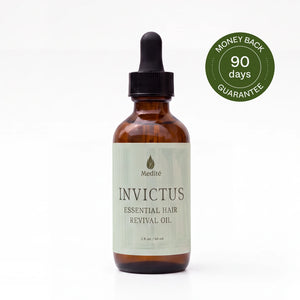
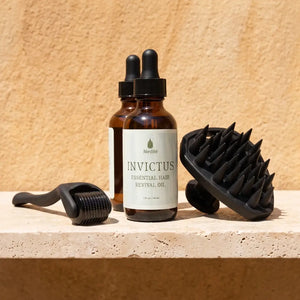
That said, supporting your scalp through the shed gives the incoming hairs the best environment to grow back strong. Keeping circulation up and the scalp healthy is the foundation, along with managing stress and making sure your diet is not short on iron, protein, or vitamin D, all of which can amplify shedding if they are lacking. A steady scalp routine is the thinking behind our Invictus Essential Hair Revival Oil and the Medíté Starter Kit, with the reasoning laid out on our Why It Works page. The goal through a seasonal shed is support and consistency, not a frantic overhaul.
When to see a dermatologist

Check in with a professional if heavy shedding lasts longer than three to six months, if you see distinct bald patches or a widening part, if your hair is not returning to its usual density, or if the shedding comes with symptoms like fatigue that could point to a thyroid or iron issue. A simple evaluation and blood work can separate a harmless seasonal shed from a treatable underlying cause.
Frequently asked questions
Is it normal to lose more hair in the fall?
Yes. Research shows hair follicles enter the resting phase most in summer, leading to a wave of shedding in autumn. For most people it is normal and temporary.
How long does seasonal hair shedding last?
Usually a few weeks to a couple of months, after which shedding returns to baseline and the hair regrows on its normal cycle.
How do I know if it is seasonal shedding or real hair loss?
Seasonal shedding is diffuse, temporary, and followed by regrowth, while pattern loss is gradual, targets the hairline and crown, and keeps progressing. Time is the clearest test.
Should I change my hair routine during a seasonal shed?
Support your scalp and stay consistent rather than overhauling everything. Manage stress and cover nutritional bases, and give the shed time to pass before judging any product.
The bottom line on seasonal hair shedding
If your hair seems to fall out more in the fall, your body is likely following a natural seasonal rhythm that research has documented, not beginning to go bald. The extra shedding is usually diffuse, temporary, and followed by regrowth.
Watch the calendar as much as the drain. A shed that fades within a couple of months is seasonal and normal. One that keeps going deserves a closer look. In the meantime, support your scalp, cover your nutrition, and let the season pass.
Sources
- Kunz M, Seifert B, Trüeb RM. "Seasonality of Hair Shedding in Healthy Women Complaining of Hair Loss." Dermatology. 2009;219(2):105-110. https://pubmed.ncbi.nlm.nih.gov/19407435/
- Randall VA, Ebling FJ. "Seasonal changes in human hair growth." British Journal of Dermatology. 1991;124(2):146-151. https://pubmed.ncbi.nlm.nih.gov/2004049/
- American Academy of Dermatology. "Do you have hair loss or hair shedding?" https://www.aad.org/public/diseases/hair-loss/insider/shedding