You're standing under the bathroom light, you glance down at your part, and it hits you: there is more scalp showing than there used to be. That thin line where you separate your hair suddenly looks like a road. Cue the spiral.
Take a breath, because a wide-looking part is one of those things that is sometimes a trick of the moment and sometimes an early signal worth paying attention to. The useful part is learning to tell which one you are looking at. Here is what a widening part actually means and what to do about it.
Why does my hair part look so wide all of a sudden?

A part can look wide for two very different reasons, and they call for completely different responses. The first is optical, meaning your hair is fine and something about the moment is exaggerating the gap. The second is real thinning, where the hair along your part has genuinely started to lose density.
The reassuring news is that a lot of the panic moments are the optical kind. But because a widening part is also one of the earliest real signs of thinning, it is worth taking seriously rather than dismissing. Let us separate the two.
The everyday reasons your part looks wider than it is

Before assuming the worst, rule out the ordinary culprits, because these fool almost everyone.
Harsh overhead lighting is the biggest offender. A bright bathroom or office light shines straight down into your part and lights up the scalp, making the gap look far wider than it does in normal light. It is the same illusion we break down in why your hair looks worse under bright lights.
Dry, clean, or freshly brushed hair separates more cleanly and lies flatter, which widens the visible part. The same goes for wet hair, which clumps together and exposes the scalp, the effect we cover in why your scalp is visible when your hair is wet. Parting in the exact same spot every day trains the hair to fall away from that line, gradually making it look wider over time even with no change in density. And a downward camera angle in a photo can make any part look dramatic, the same distortion behind why your hair looks thinner in photos.
If your part looks wide only in certain lighting, only when wet, or only in one unflattering photo, it is very likely one of these, not a real change.
When a widening part is a real sign of thinning

Sometimes, though, the part really is widening, and it pays to recognize it early. A genuinely widening part is one of the first visible signs of pattern hair loss.
The reason is a process called follicle miniaturization. Under the influence of the hormone DHT, sensitive follicles gradually shrink, producing hairs that are finer, shorter, and less able to cover the scalp with each cycle. Because this happens right across the top of the head where your part sits, the part line is often where you notice it first. Our explainer on what DHT is covers that mechanism.
A real widening often follows a recognizable pattern. The part gets progressively wider over three to twelve months, more scalp shows along its whole length rather than in one lit-up spot, and in many people it fans out toward the front in a shape dermatologists call the Christmas tree pattern. Clinicians even grade this with a tool called the Savin Scale, which measures pattern loss by how wide the part has become.
One sobering fact makes early attention worth it: people often lose around 30 to 40 percent of their density in an area before the change becomes obvious to the eye. So if your part genuinely looks different, the process has usually been quietly underway for a while, which is exactly why acting sooner matters.
How to tell the difference

The single best test is photographs over time, because your memory and the daily mirror will lie to you. Take a clear photo of your part in the same neutral lighting, from the same angle, every few weeks. A part that is stable is just reacting to the moment. A part that is genuinely widening across consistent photos is telling you something real.
A quick second check: part your hair in a different spot than usual. If the new part looks full and the old one looked wide, the old part was mostly trained and lit, not thinned. If scalp shows through wherever you part, that points more toward genuine thinning.
What you can do about a widening part

If it is optical, the fix is easy. Switch your part to a different spot to redistribute the hair and break the trained line, avoid parting in the same place daily, and be kind to yourself about harsh lighting and unflattering angles.
If there are early signs of real thinning, the priority is supporting density while the follicles are still active, because early is when you have the most to work with. That means looking after the scalp environment those follicles grow in, keeping circulation up and inflammation down, alongside the general strategies in how to get thicker hair naturally.
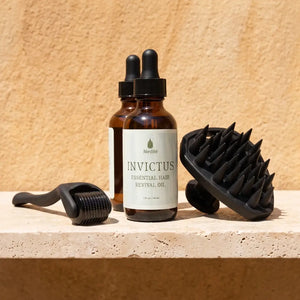
A scalp-focused routine fits here. Rosemary and peppermint, the two most researched natural oils for hair, support circulation and a healthy scalp, which is the thinking behind our Invictus Essential Hair Revival Oil and the Medíté Starter Kit, with the evidence on our Why It Works page. Used consistently on follicles that are thinning but still active, it supports the density you are trying to hold onto.
Can a widening part get better?

If the cause is optical, it improves the moment you change your part or your lighting. If it reflects early thinning, follicles that are shrinking but still alive can be supported, and a fuller-looking part is a realistic goal, though follicles lost entirely will not return.
Either way, patience is required, because hair grows on a months-long cycle and visible change lags well behind what is happening at the follicle. This is exactly why catching a widening part early gives you the biggest advantage.
Frequently asked questions
Is a widening part always a sign of hair loss?
No. Lighting, dry or wet hair, always parting in the same spot, and camera angles can all make a part look wider without any real thinning. Consistent photos over time tell you whether it is genuinely changing.
How do I know if my part is actually getting wider?
Take photos in the same lighting and angle every few weeks, and try parting your hair in a different spot. A part that only looks wide in certain conditions is optical, while one that widens across consistent photos points to real thinning.
What does an early-thinning part look like?
It widens gradually over several months, shows more scalp along its whole length, and often fans toward the front in a Christmas tree shape, rather than lighting up only under a harsh bulb.
Can I make my part look fuller?
Yes. Switching your part, avoiding the same daily line, and supporting a healthy scalp all help, and acting early gives the best results if real thinning has begun.
The bottom line on a widening part
A part that suddenly looks wide is often just harsh light, wet or dry hair, or a trained parting line, not hair loss. But because a genuinely widening part is one of the earliest signs of thinning, it is worth checking honestly rather than ignoring.
Track it with consistent photos, test a different part, and if it is truly changing, support your scalp early while the follicles are still in the game. Read correctly, a wide-looking part is not a verdict. It is information, and often an early chance to act.
Sources
- American Academy of Dermatology. "Thinning hair and hair loss: Could it be female pattern hair loss?" https://www.aad.org/public/diseases/hair-loss/types/female-pattern
- Cleveland Clinic. "Female Pattern Baldness: Symptoms, Stages, Causes & Treatment." https://my.clevelandclinic.org/health/diseases/24943-female-pattern-baldness
- Ramos PM, Miot HA. "Female Pattern Hair Loss: an Update." Anais Brasileiros de Dermatologia / PMC. https://pmc.ncbi.nlm.nih.gov/articles/PMC7413422/