It usually happens by accident. Someone snaps a photo from behind, or you catch the back of your head in a two-mirror angle, and there it is: a patch at the crown where the scalp shows through more than you remember. For a lot of people, the crown is where hair loss quietly announces itself.
So why is your crown thinning, and is it as bad as that unflattering photo made it look? The answer depends on whether you are seeing genuine thinning or just the way the crown naturally sits, and there is a real difference. Here is how to read it and what to do.
Why is my crown thinning?

The most common reason a crown thins is androgenetic alopecia, better known as male or female pattern hair loss. It is a gradual, progressive condition driven by the hormone DHT, and the crown, also called the vertex, happens to be one of the areas most sensitive to it.
DHT slowly shrinks the follicles it affects through a process called miniaturization, so each new hair grows in finer and shorter until the coverage at the crown thins out. Because this unfolds over months and years rather than all at once, crown thinning tends to creep up quietly, which is exactly why the back-of-the-head photo can feel like such a shock. Our explainer on what DHT is covers the mechanism behind it.
Is my crown actually thinning, or is it just my swirl?

Before you assume the worst, know that the crown naturally shows more scalp than anywhere else on your head, even with a full head of hair.
Your hair grows in a spiral pattern at the crown, radiating out from a central point called the whorl. Because the hair fans away from that single point, the scalp underneath is simply more visible there, especially right at the center of the swirl. This is normal anatomy, not loss.
A few everyday conditions exaggerate it, the same ones that fool people elsewhere on the scalp. Harsh overhead lighting shines straight down into the crown, the effect we cover in why your hair looks worse under bright lights. Wet hair clumps and exposes the scalp, as in why your scalp is visible when your hair is wet. And a downward camera angle distorts the whole area, just like in why your hair looks thinner in photos. If your crown only looks sparse when wet or under a bright bulb, that swirl and the lighting are probably doing the talking.
Why the crown is the last place you notice thinning

The crown has a cruel quirk: it is the hardest part of your own head to see, so thinning there often progresses further than a hairline would before you catch it.
You look at your hairline every time you face a mirror. You almost never see your crown unless you deliberately check it or someone points it out. That blind spot is why crown thinning is so often discovered in a photo, on a video call, or through an offhand comment, rather than in the mirror. It has usually been developing for a while by the time it registers.
What crown thinning looks like as it progresses

Genuine crown thinning follows a fairly predictable path, which dermatologists track using the Norwood scale in men.
It typically begins as a slightly more open area at the center of the whorl, where the scalp becomes gradually more visible across a widening circle. In men, pattern loss often starts at the temples and hairline first, with the vertex thinning appearing a bit later and expanding outward from the crown over time. The key signal is progression: a crown that shows more scalp across consistent photos over several months, rather than one that only looks thin under bad lighting.
Crown thinning versus a receding hairline

These are two fronts of the same process, and many people experience one, the other, or both. A receding hairline moves backward from the forehead and temples, while crown thinning opens up from the swirl at the back. Both are driven by DHT and follicle miniaturization, just in different locations. If your concern is the front rather than the back, our piece on receding hairlines and what helps covers that side of the pattern.
Not all crown thinning is genetic, either. Diffuse shedding from stress, illness, or a nutritional shortfall can thin the crown too, though that tends to spread across the whole scalp rather than concentrate at the vertex. Our overview of why hair thins lays out the range of causes.
Can crown thinning be reversed or slowed?

Here is the encouraging part. The crown tends to respond relatively well to treatment, and follicles that are thinning but still active can often be supported, especially if you act early.
The single biggest advantage you have is timing. Follicles that have miniaturized but not yet died back can still be helped, while areas that have gone completely bare are much harder to bring back. Early, consistent attention is what separates a good outcome from a frustrating one, which is why noticing your crown sooner is genuinely useful rather than just alarming.
Supporting the scalp environment matters here. Keeping circulation up and the scalp healthy gives those crown follicles the best conditions to hold and thicken, alongside the broader strategies in how to get thicker hair naturally.
How to check your own crown properly

Since you cannot see it directly, set up a reliable way to track it rather than relying on random photos that panic you.
Use your phone. Hold it above and behind your head and take a photo of your crown in the same neutral, indirect lighting each time, ideally on dry hair styled as usual. Repeat every few weeks and compare side by side. A crown that looks the same across consistent shots is stable and probably just showing its natural swirl. A crown that opens up progressively across those photos is telling you something real, early enough to act on.
What actually helps a thinning crown

If it is early pattern thinning, the goal is to support the follicles while they are still active. A scalp-focused routine fits naturally here, since the crown responds to better circulation and a healthy scalp just like the rest of the head.
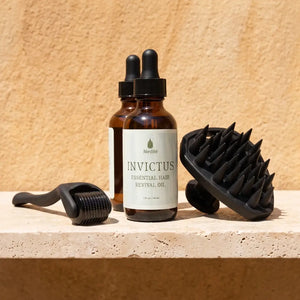
Rosemary and peppermint, the two most researched natural oils for hair, support scalp circulation, which is the reasoning behind our Invictus Essential Hair Revival Oil and the Medíté Starter Kit, with the evidence laid out on our Why It Works page. Massaging a supportive oil into the crown also gives you a reason to reach an area you otherwise neglect. For thinning that is advancing quickly, it is worth pairing scalp care with a dermatologist's input on proven medical options.
Frequently asked questions
Is crown thinning always permanent?
No. Crown thinning caught early, while follicles are miniaturized but still active, can often be supported and improved. Areas that have gone fully bald are much harder to regrow, which is why acting early matters.
How do I know if my crown is thinning or if it is just the swirl?
The crown naturally shows more scalp at the whorl. Take consistent photos in the same lighting over several weeks. A stable crown is just its natural pattern, while one that progressively opens up points to real thinning.
Why is my crown thinning but not my hairline?
The crown is one of the areas most sensitive to DHT, and in some people pattern loss shows up at the vertex before or instead of the hairline. Both are part of the same process in different locations.
Does crown thinning respond to treatment?
Yes, the crown often responds relatively well, especially early. Supporting scalp health and addressing the cause promptly give the best chance of holding and thickening the area.
The bottom line on crown thinning
A crown that looks thin is sometimes just its natural swirl exaggerated by lighting, wet hair, or a bad camera angle. But because the vertex is highly sensitive to DHT and hard to see, genuine crown thinning is common and often noticed late.
Track it with consistent overhead photos, compare honestly over time, and if it is truly progressing, support the scalp early while those follicles are still active. The crown may be your blind spot, but caught in time it is also one of the more responsive areas to work on.
Sources
- Ho CH, Sood T, Zito PM. "Androgenetic Alopecia." StatPearls, NCBI Bookshelf. https://www.ncbi.nlm.nih.gov/books/NBK430924/
- Bosley. "The Norwood Scale, Class 1 to 7: Understanding Male Pattern Hair Loss." https://www.bosley.com/blog/norwood-scale/
- American Academy of Dermatology. "Hair loss: Diagnosis and treatment." https://www.aad.org/public/diseases/hair-loss/treatment/diagnosis-treat